Last updated: 2026-09-09
Online hearing test accuracy is a fair thing to question before you trust the result — these free tools are convenient, but they measure something meaningfully different from what happens in a clinical hearing evaluation. A free online or app-based hearing screener can be a genuinely useful first step for deciding whether you need professional help, but it cannot diagnose hearing loss, determine its cause, or replace a booth-based audiometric test. This guide explains how these screeners actually work, what they're built to catch, where they fall short, and how to read your results without over- or under-reacting to them.

Dr. Jennifer Walsh is a Doctor of Audiology with 14 years of clinical practice fitting hearing aids and diagnosing adult hearing loss. Read more about our testing methodology or view full bio.
Most free online and app-based hearing tests use one of two approaches: pure-tone detection or speech-in-noise testing. Pure-tone screeners play a series of tones at different pitches and gradually increasing or decreasing volumes through your headphones, asking you to tap a button whenever you can hear the tone. The app records the softest volume at which you responded at each pitch, which is a simplified version of the same principle used in clinical audiometry.
Speech-in-noise screeners, which some researchers consider more predictive of real-world hearing difficulty, play short words or number sequences against a background of competing noise or babble and ask you to identify what was said as the noise level increases. Because everyday hearing complaints are so often about understanding speech in noisy environments rather than detecting a pure beep in silence, this style of test can pick up on functional difficulty that a pure-tone test might miss in someone with relatively mild threshold changes.
Both approaches run entirely on your own device and headphones, using software calibration rather than the specialized, regularly-calibrated audiometric equipment used in a clinical setting. That distinction — consumer hardware and guesswork calibration versus calibrated clinical equipment — is the single biggest reason these tests are described as screeners rather than diagnostic tools.
Despite their limitations, free hearing screeners are useful for exactly what they're designed to do: flagging that something may be off and encouraging follow-up. If a screener consistently shows you missing tones at certain pitches across repeat attempts, or if a speech-in-noise test shows notably poor performance compared to typical scores for your age group, that's meaningful directional information. It won't tell you the exact severity or type of loss, but it's a reasonable signal that a real evaluation is worth scheduling.
These tools are also genuinely helpful as a low-friction way to get people who are on the fence to take a first step. Many people delay getting a hearing test for years, partly out of inconvenience and partly out of denial about the early signs of hearing loss they've been noticing. A five-minute app test that flags a possible problem is often the nudge that gets someone to finally book a professional appointment, and in that sense their value isn't really about precision — it's about lowering the barrier to taking hearing health seriously.
The single biggest source of error in any online hearing test is the environment you take it in. Clinical hearing tests happen in a sound-treated booth specifically built to eliminate ambient noise, because even a quiet-seeming room has a noise floor — HVAC systems, traffic outside, a refrigerator hum, other people in the house — that can mask the very quiet tones used to measure your true hearing threshold. If you take an online test in your living room, that ambient noise raises the effective volume needed for you to detect a tone, which can make your hearing look worse than it actually is, particularly at low frequencies where background noise is concentrated.
The opposite error is also possible. If you take the test somewhere unusually quiet with headphones that block outside sound well, you might score better than you would in a typical listening environment, masking a real difficulty you experience in everyday noisy settings. Either way, the lack of a controlled, consistent environment means your score can shift meaningfully from one attempt to the next depending on where and when you take it — something that essentially never happens with a properly administered booth test.
| Factor | Online/App Screener | Booth Audiometric Test |
|---|---|---|
| Environment | Home, uncontrolled ambient noise | Sound-treated, calibrated booth |
| Equipment | Your own headphones/earbuds, uncalibrated | Calibrated audiometer and clinical headphones |
| Can diagnose type of loss | No | Yes (conductive, sensorineural, mixed) |
| Can determine cause | No | Yes, with additional exam (wax, infection, nerve issues) |
| Detects one ear vs. both | Sometimes, with headphone-specific playback | Always, tested per ear individually |
| Cost/time | Free, 3-10 minutes | Often free or low-cost, 30-60 minutes |
| Best use | Initial screening/nudge to seek care | Diagnosis and treatment planning |
Every pair of headphones and earbuds has its own frequency response — meaning it naturally emphasizes some pitches and dampens others. Clinical audiometry uses standardized, calibrated headphones (or insert earphones) whose output has been precisely measured, so the volume the software requests is the volume actually delivered to your ear. Consumer headphones have no such guarantee. A pair of earbuds with a bass-heavy tuning might make low-pitch tones easier to hear than they should be, while noise-cancelling headphones can distort results by actively suppressing certain frequencies even when the cancellation is meant to target ambient sound rather than the test tones themselves.
The device's speaker or headphone amplifier also matters. Phone and laptop volume controls aren't calibrated to a decibel standard the way clinical equipment is, and the maximum volume, minimum volume, and steps in between vary by device and even by software version. This is part of why a single online test score should be treated as a rough estimate rather than a precise number, and why comparing your score across two different devices, or against a friend's results on a different phone, isn't a meaningful comparison at all.
Even a well-designed online hearing screener has a hard ceiling on what it can determine, and it's worth being clear-eyed about this before relying on one. It cannot distinguish between conductive hearing loss — often caused by earwax blockage, fluid, or a middle-ear problem, and frequently treatable — and sensorineural hearing loss caused by inner-ear or nerve damage, which is typically permanent but very manageable with hearing aids. Since the treatment path for these two categories is completely different, this distinction matters enormously, and no home screener is built to make it.
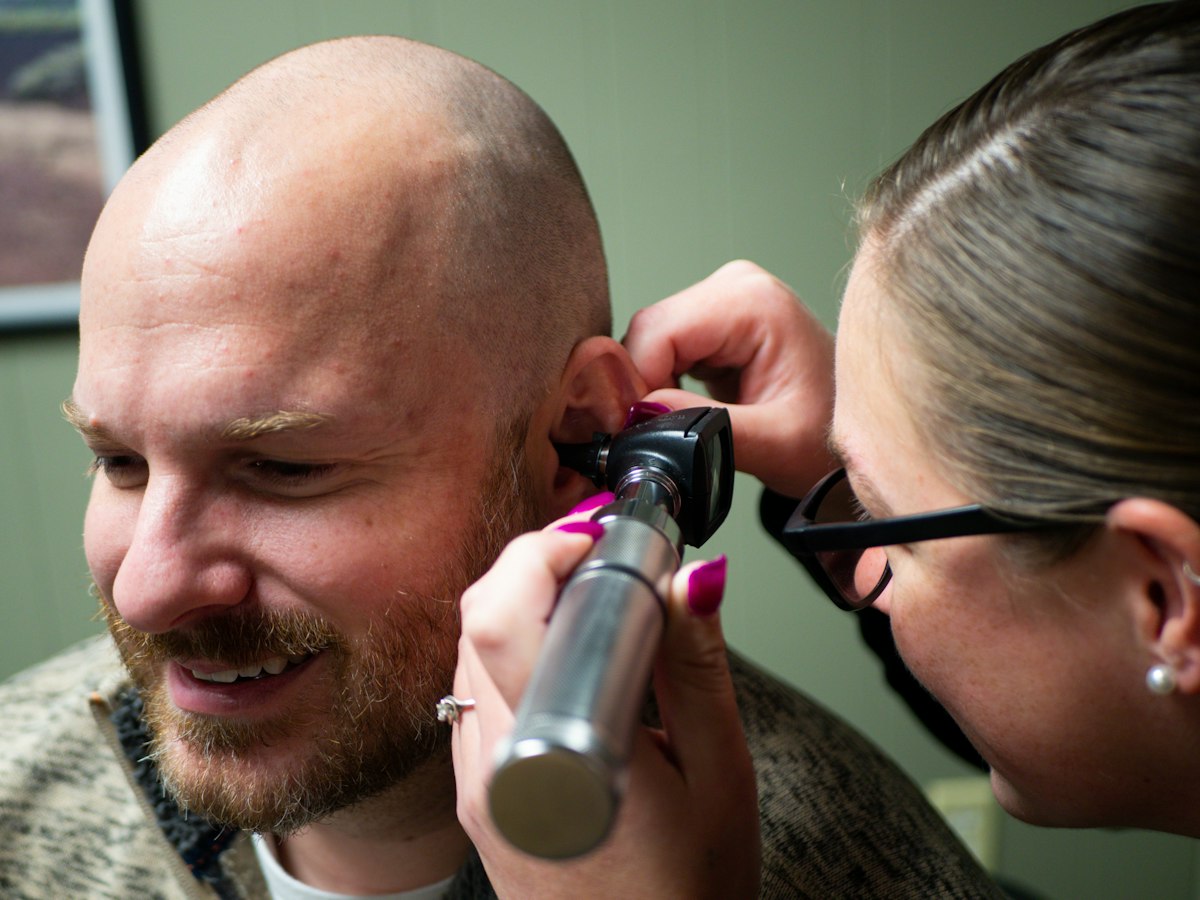
A screener also can't examine your ear canal, which means it will miss a simple, fixable cause like impacted earwax that might be creating the exact symptoms you're worried about. It can't measure how well you understand speech using the specific frequency shaping a hearing aid would apply, and it can't account for asymmetries between your ears with the same precision as an ear-by-ear clinical test using insert earphones. If you experience ringing or buzzing in your ears (tinnitus) alongside hearing changes, a home screener has essentially nothing to offer in terms of identifying why, since tinnitus has several distinct underlying causes that require a real examination to sort out.
If you decide to take an online hearing test, a few adjustments make the result more useful even though they can't fully overcome its inherent limits. Take it in the quietest room available, ideally with external doors and windows closed and other people and devices silenced. Use wired headphones rather than Bluetooth earbuds where possible, since wireless audio compression and processing can subtly alter what's actually delivered to your ear, and avoid any headphones with active noise cancellation engaged, since it can interfere with tone delivery. Set your device volume to a fixed, moderate level rather than adjusting it mid-test, and take the test more than once on different days to see whether the result is consistent rather than trusting a single attempt.
It's also worth choosing a screener from a reputable source — a hospital system, a well-known hearing aid manufacturer, or an established audiology organization — over an obscure app with no clear methodology, since test design quality varies widely. Whatever the result, treat it as a screening signal rather than a diagnosis: a "pass" doesn't rule out early-stage loss, especially the kind that shows up specifically in noisy environments rather than quiet ones, and a "fail" doesn't confirm the type or severity of any loss you might have.
A few situations should move you toward a professional evaluation regardless of what a free test says. If you're experiencing any of the behavioral signs of hearing loss — turning up the TV, struggling in restaurants, frequently asking people to repeat themselves — book an appointment even if an online screener came back reassuring, since these tools are more sensitive to significant loss than to the earlier, milder changes many people first notice. If an online test flags a likely problem, particularly a consistent one across repeat attempts, that's a clear signal to schedule a booth test rather than trying more free apps to get a better answer.
Certain symptoms warrant prompt medical attention rather than a routine screening at all: sudden hearing loss in one or both ears, hearing loss following an ear infection or head injury, hearing loss accompanied by dizziness or ear pain, or tinnitus that pulses in time with your heartbeat. None of these should wait on an app-based test — they call for a doctor or audiologist directly. For everyone else, a reasonable rule of thumb is to treat a free online test as a starting point: useful for building awareness and motivation, but the actual decision about hearing aids or treatment should always rest on a full clinical evaluation, the kind covered in our guide to what hearing aids cost and how the fitting process works.
No. They can reasonably flag that something may be wrong, but they are not calibrated or comprehensive enough to replace a booth-based audiometric test, and they cannot diagnose the type or cause of any hearing loss they detect.
Variability in your listening environment, headphone placement, background noise, and even how alert you were at the time can all shift the result. This inconsistency is one of the core limitations of uncontrolled, at-home testing compared to a standardized clinical setting.
Not necessarily more accurate, but often more thoughtfully designed, since many use speech-in-noise formats that better reflect real-world listening difficulty. They still share the same fundamental limitations of uncalibrated equipment and an uncontrolled environment.
Retaking it once or twice on different days can help you see whether a concerning result is consistent, but repeated free testing shouldn't be used as a substitute for scheduling an actual evaluation if you're experiencing real-world hearing difficulty.
Free online and app-based hearing tests occupy a useful but narrow role: they're a reasonable way to get a first read on whether your hearing may have changed, and a good nudge to finally take action if you've been putting it off. What they can't do is replace the precision of calibrated equipment, a controlled sound environment, and a trained professional's ability to identify the type and cause of hearing loss. If a free screener raises a concern, or if you're already noticing everyday listening difficulty regardless of what an app tells you, the most reliable next step is a full clinical hearing evaluation rather than another round of testing on your phone.
Independent testing. No manufacturer pays for placement on this site.